September 29, 2025
AI is Germany on Steroids
Every culture meets technology differently. Some cultures absorb it like a mirror; others use it like a counterweight. That’s why the arrival of AI doesn’t feel the same in Rome as it does in Berlin.
Germany is already - in its cultural DNA - deeply AI-like: orderly, rational, predictable, obsessed with structure. Social life runs on timetables, bureaucracy stacks up like Lego bricks, even spontaneity tends to be scheduled in advance. When smartphones and social media arrived in the 2010’s, they didn’t open things up here — they pulled people further inward. German youth became colder, more self-contained, less willing to take social risks.
So what happens when you drop AI — itself built on rules, data, predictability — into this environment? You don’t get balance. You get amplification. Sterility doubled. The cold grows colder. The introspective turns hyper-introspective. Life risks becoming so neatly optimized that unpredictability — the human spark — vanishes altogether.
Contrast that with Southern Europe, the Middle East, or Latin America. Cultures that thrive on warmth, emotion, improvisation. Drop AI there, and it plays a different role. It doesn’t suffocate; it steadies. It doesn’t double down; it balances out. AI as counterweight feels almost healthy.
So maybe the question isn’t “what does AI do?” but “where does it land?”. In Germany, it risks creating a society where everything is efficient, structured, optimized — and dead boring. In Italy or Venezuela, it might smooth the chaos without killing the joy.
In short: AI isn’t neutral. It’s cultural chemistry. In some places, it stabilizes. In Germany, it might just be a dose too strong. Which flips the Turing Test on its head: maybe it isn’t whether AI can think like us anymore — but whether we dare to live unlike it.
———
PS. The seed for this reflection came from my first weeks of my master’s program in Potsdam. I’m (ironically) the only German in my cohort, surrounded by students from Latin America, Mexico, India, Thailand, the Middle East and many more. More than once, people asked me why Germans seem so cold, distant, or self-contained. I honestly didn’t know how to answer at first. But those conversations made me wonder whether Germany’s deep attachment to order and control doesn’t just shape institutions — it also shapes how Germans come across to others. This short essay was my attempt to reflect on that in the context of AI mass adoption in western cultures.
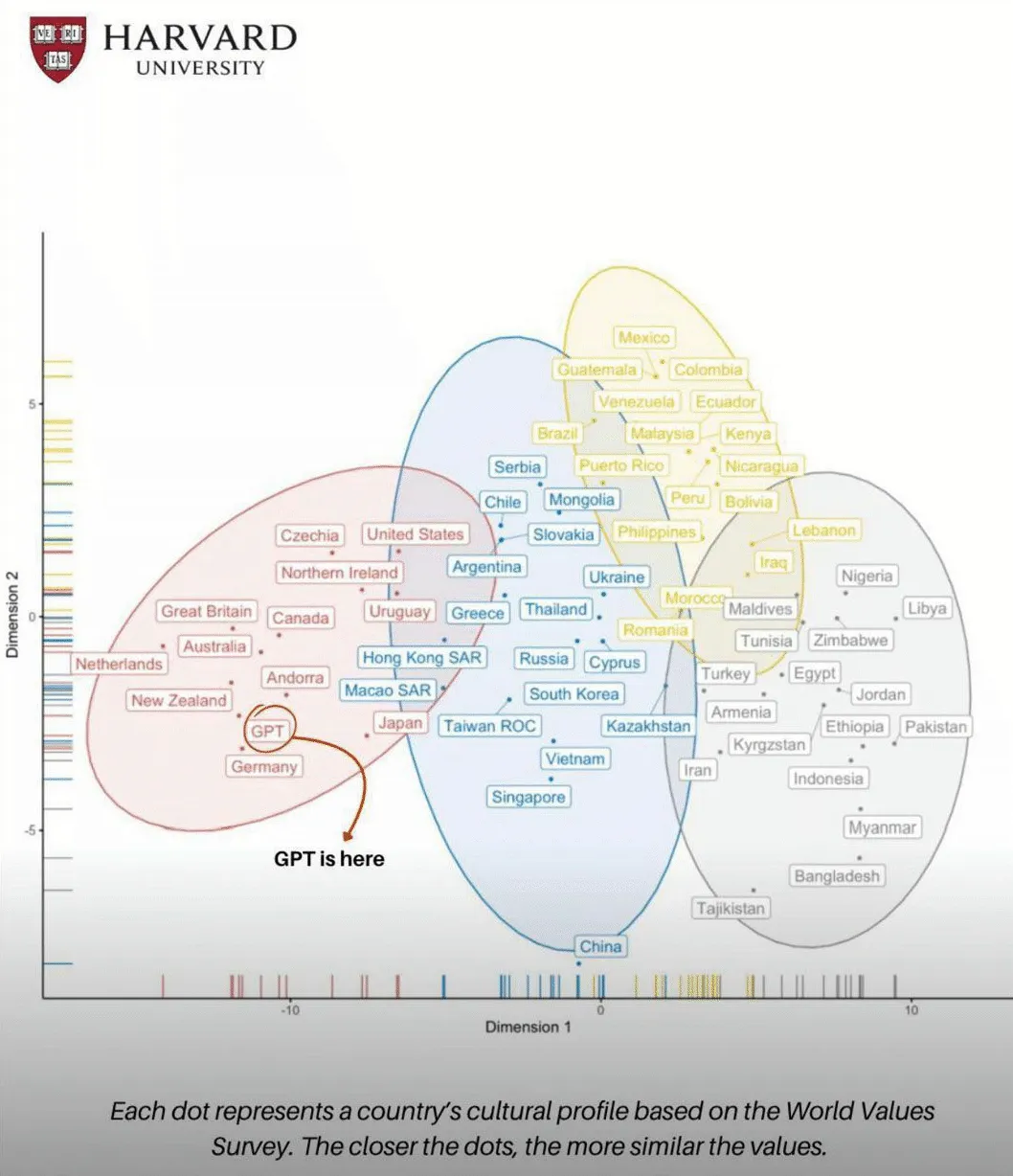
Edit (Dec. 2025): Coincidentally, I stumbled across this graph on LinkedIn showing the cultural bias of ChatGPT. To my surprise it was situated right between Germany and New Zealand. In Germany, we would now say: “Zufall? Ich glaube nicht!”.