September 14, 2025
The Abrahamic Script Beneath a Post-Religious West
Western life is built like a straight road. One beginning, one middle, one end. Childhood, school, career, retirement. Birth, sin, salvation, judgment. Always forward, never back. Always with the weight of finality: miss a step, and the door closes. That linear script isn’t accidental. It’s a child of the desert.
When I speak of the “desert script” I’m not saying the Desert itself is linear, since it has cycles of sun and moon, wind and stillness. However, those rhythms don’t renew human life—they only repeat its danger. Miss water once and you die; shade comes again tomorrow, but not for you. The environment writes its lessons in absolutes: oasis or wasteland, survival or ruin. Out of that soil grew religions with the same starkness: one life, one judgment, heaven or hell. In contrast, traditions born in fertile landscapes inherited the logic of recurrence: crops regrow, seasons return, mistakes can be repaired. The desert taught finality; the fields and forests taught renewal.
The Abrahamic religions—Judaism, Christianity, Islam—took that harsh geography and encoded it into narrative form: Eden or exile, sin or salvation, heaven or hell. For centuries, these stories ordered Western existence, fusing ecology with theology. And even as explicit belief faded in the West, the myths endured. Cultural scripts outlast religious faith; you don’t have to believe in heaven and hell to live by their structure. Capitalism inherited the same linear urgency—progress measured step by step, ladder by ladder.
Modern Digital Technology— born of capitalism— carried it further, binding our attention to straight lines of data, feeds, and deadlines. In this sense, the West may call itself post-religious, but under the hood it still runs on Abrahamic Scripts. The myths survive not in churches but in universities, offices, and Instagram feeds—still whispering Eden and exile, sin and redemption, one chance, one judgment.
Over centuries, this Desert Script - through religion - seeped so deeply into Western culture that even our secular lives follow its linear arcs. Education is cast as a one-shot audition: perform well in school or lose your chance at the “good life.” University feels like a cliff edge—get the right degree or tumble into irrelevance and precarity. Careers are ladders, each rung a test you can’t repeat. Relationships become milestones—marriage, children, property—each framed as proof that the struggle before was “worth it.”
And that’s the deeper inheritance: not just linearity, but the belief that suffering is the precondition for meaning. The West romanticises struggle because its myths demand it. You suffer now so that point X—graduation, marriage, promotion, salvation—redeems it later. The desert makes pain into currency. “Nothing good comes easy”, “No pain, no gain”, “Your comfort zone kills you”, we tell ourselves, echoing a theology that insists redemption only follows crucifixion. Even Western hero tropes recycle this: the chosen one must endure trial, humiliation, exile, only to emerge “worthy.” This isn’t just a cultural habit—it’s the Abrahamic script of suffering and redemption echoing through secular life. What was once theology has become a cultural reflex.
Contrast this with Eastern traditions, where suffering is often illusion or error, something to be seen through or even dissolved. Or with Epicurus in the West, who counseled: minimise pain, seek simple joys, live quietly. That softer path was buried beneath desert logic, where pain was sanctified as the toll for paradise. Agrarian religions taught cycles; Abrahamic ones taught judgment. Even now, our supposedly secular culture still speaks the language of Abraham: to struggle is holy, to suffer is meaningful.
Technology only sharpened the script. Electricity runs in straight lines, not seasons. Servers don’t hibernate; screens don’t sleep. The iPhone isn’t just the Tree of Knowledge—it’s the apple itself, bitten and glowing. Here the Abrahamic myth lingers: innocence lost in a single irreversible act, exile triggered by one choice. Children taste it at six years old, long before any mythic age of innocence should have ended. They fall from Eden prematurely, scrolling into exile before they even know what innocence is.
This is where modern feelings of alienation enter the picture. Because most of us don’t live in deserts. We live in cities or villages surrounded by forests, valleys, coastlines. We live in places where time isn’t linear but cyclical. Seasons return. Trees regrow. Crops fail but can be replanted. Nature whispers renewal, but our systems shout deadlines. It isn’t that capitalism or technology are inherently alienating—they thrive in places like Dubai, where desert geography matches desert logic. The alienation comes from mismatch: cyclical soil carrying linear myths.
Screens deepen this mismatch. Every time we stare into them, we’re plugged into the Desert Script—linear feeds, endless scrolls, steady streams of energy and information without pause or season. “Always on”-Displays birth an “always on”-lifestyle birthing a 24/7 culture. Our eyes live in the desert even when our bodies live in forests and fields. That’s why the gap feels suffocating: the world inside the glass is linear, absolutist, desert-born. The world outside the glass is cyclical, patient, alive.
Eastern traditions remind us there are other ways of telling time. Hinduism, Buddhism, Daoism—religions born in agrarian landscapes—see life as cycles. Karma loops, samsara turns, yin follows yang. Failure isn’t final, it’s folded back into the next return. You don’t miss your one chance; another season comes. That’s what Western culture has forgotten: that renewal is natural. That Eden isn’t lost forever. That exile doesn’t have to be permanent. Yet our lives are still written in desert ink, where every chance feels like the last, every fall like a luciferian eternal damnation.
So to conclude, the alienation of the West doesn’t come from capitalism or technology being alienating forces themselves, but from the Abrahamic Desert Script they inherited. That logic may fit a desert, where life truly is all or nothing, but it jars against the cycles of forests and fields. The mismatch between our landscapes and our systems is what alienates us. And maybe the answer isn’t forward at all, but sideways—toward rhythm, recurrence, seasonality, toward breathing with the world again. Or— if we can’t break our iPhone addiction— at least being honest with ourselves and just moving to Dubai.
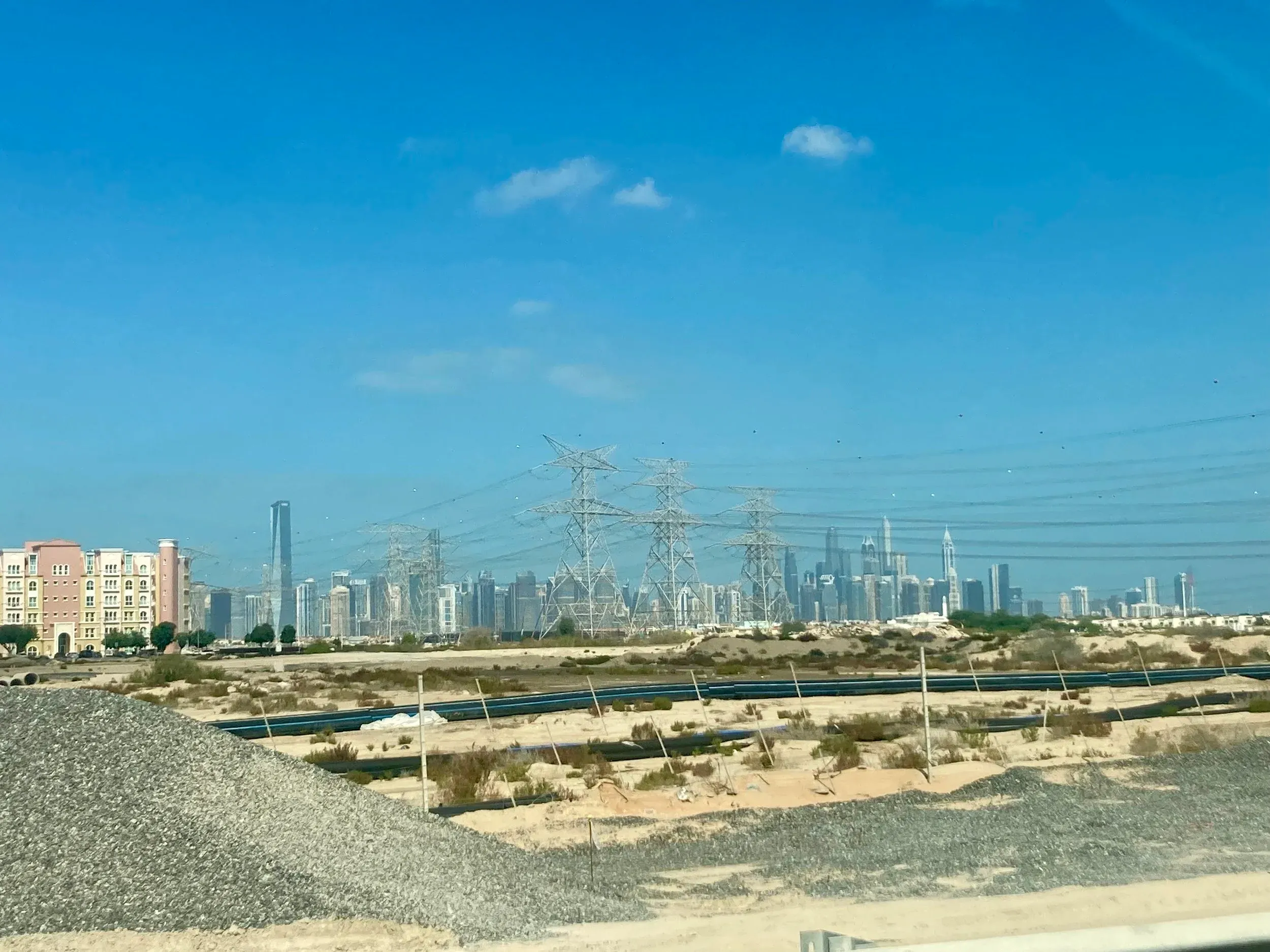
📍Sheikh Mohammed Bin Zayed Road, Dubai, United Arab Emirates [19/02/24 | 11:14:50], 25,02504° N, 55,16385° E