September 14
Britney 2007 Revisited
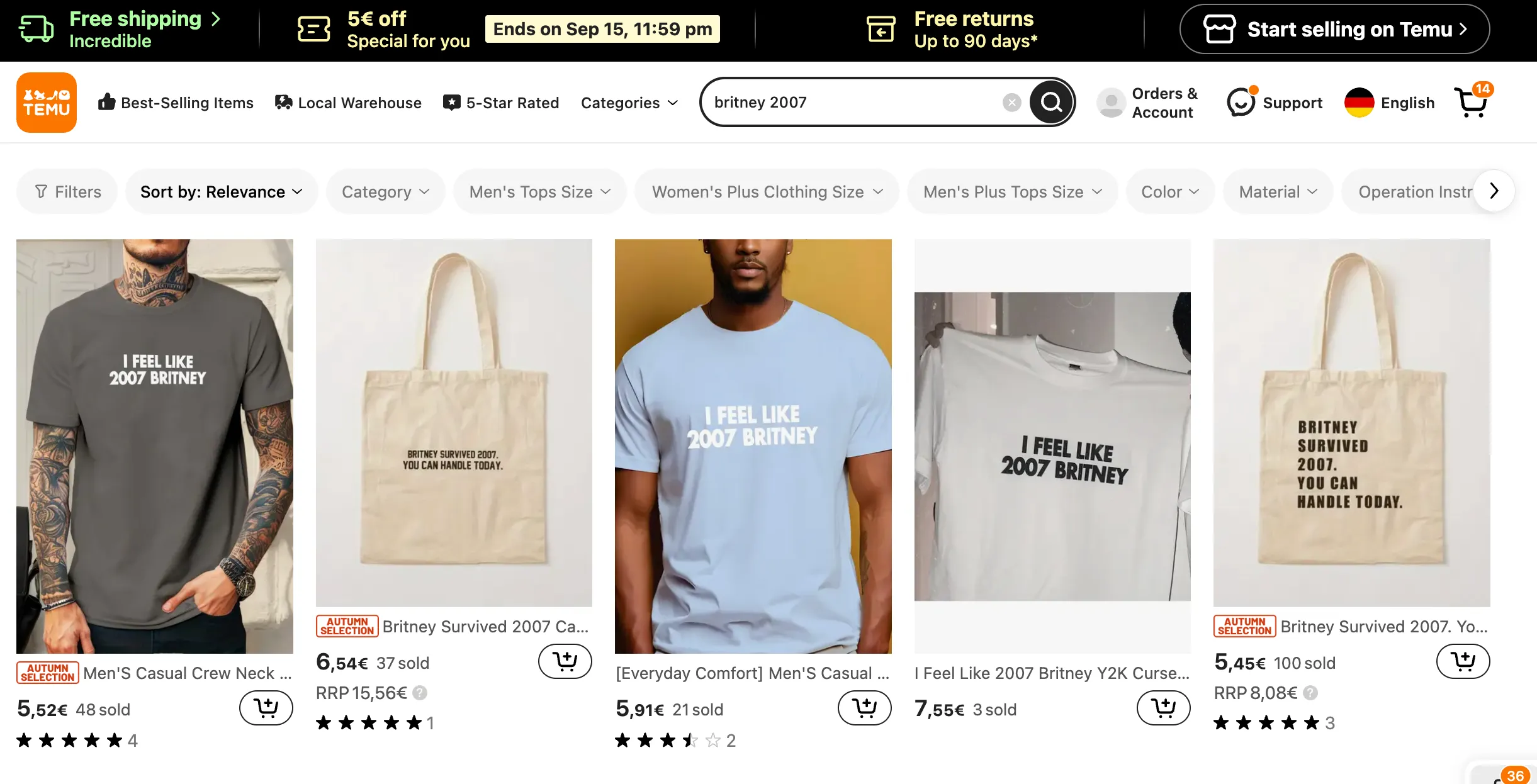
It didn’t start in 2007 for me — it started on Temu. I was scrolling through the endless grid of cheap shirts and tote bags when I saw two slogans that made me stop: “Today I feel like 2007 Britney” and “Britney survived 2007, you can handle today.” I laughed, then realized: I actually didn’t know what “2007 Britney” meant exactly. It felt like one of those glaring cultural blind spots — like everyone else was in on a joke I’d somehow missed. So I did what you do when you’re late to the party: I asked ChatGPT and then googled images.
And there she was — shaved head, heavy black eyeliner, neon-green umbrella raised against a car window in some dimly lit parking lot, paparazzi cameras firing all around her. At first glance, it looked absurd, almost staged. Meme material. But the longer I stared, the more it shifted. It wasn’t just a breakdown. It looked like revelation. Britney wasn’t Britney anymore — she looked like a pharaoh.
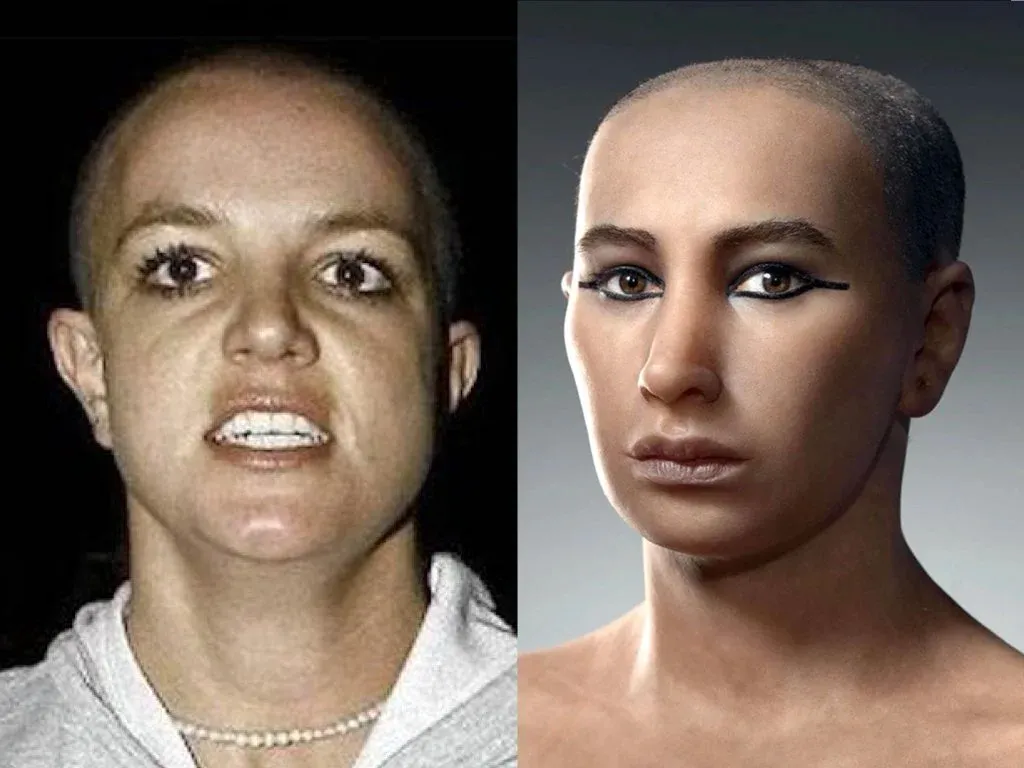
Britney Spears - mid-meltdown - side-to-side with Tutankhamun’s reconstruction: both bald, both lined in thick kohl, both youth icons trapped in spectacle. He was the ‘Boy King,’ she the princess of teen-pop — frozen in time as symbols of fragile power and collective obsession. Image: Backgrid/X17Online & Facial reconstructions of Pharaoh Tutankhamun based on CT scans
The bald head, the thick kohl eyeliner, the rigid fury in her face — straight out of Egyptian iconography. Suddenly, this wasn’t just tabloid chaos but something archetypal. And that got me thinking: maybe Britney’s “meltdown” wasn’t collapse at all, but the modern world accidentally revealing its gods.
Nietzsche warned us about this. “God is dead, and we have killed him.” The point wasn’t just loss of belief — it was that we’d left a vacuum where divinity used to be. And vacuums always get filled. In our era, they’ve been filled by celebrities. Politicians still grind away in the mud of earthly power: corrupt deals, compromises, dirty pragmatism. They’re rulers, but they don’t feel divine. Celebrities, by contrast, inhabit the sky. Like the Olympians, they radiate purity and aura. They don’t govern, they glow. They’re untouchable icons of desire, closer to gods than any president or prime minister could ever be. And Britney - at her peak - didn’t just play in this system — she ruled it. In ’07, she was the pharaoh of the attention economy.
That’s why her gesture in 2007 hits differently when you reframe it. Shaving her head wasn’t random chaos; it was ritual. Shaving the head has always been a gesture of renunciation, purification, rebellion. The heavy eyeliner mirrored the protective kohl pharaohs wore in desert sun — here, a shield against paparazzi glare. The parking lot became her temple, paparazzi the chorus, umbrella her inverted scepter.
And when she struck, she didn’t strike a person — she struck a car. Not just any car, but the paparazzi’s car. And that choice matters. Because for Britney, cars had become paranoia objects. They were the rolling panopticon, the vessels of the gaze. Any car idling by the curb could be the one carrying lenses aimed at her, ready to capture a slip, a crack in the mask. Her pop persona had been engineered into a striated image — rigid, ordered, endlessly repeatable. The paparazzi - by contrast - functioned like a nomadic war machine, probing for cracks, ambushing from the edges, always threatening to undo the fixity. The car wasn’t just a vehicle; it was the mobile instrument of that chase. By smashing it, Britney wasn’t just lashing out. She was striking at the entity that hunted her identity from the outside. The pharaoh is defending the state apparatus (fixed pop-idol identity) against attempts by the nomadic war machine (the paparazzi) to undermine it.
And in doing so, she flipped the script. The paparazzi’s job was to catch her off guard, to ambush her in a moment where the carefully constructed pop-idol identity slipped. But Britney beat them to it. She gave them the breakdown they wanted — except bigger, wilder, and totally over-the-top. She ripped off the mask herself - violently - on her own terms. “Here’s the meltdown you’ve been waiting for,” the gesture seemed to say. “Now you don’t need to chase me anymore.” She didn’t just expose herself — she annihilated the whole chase.
Also, the parking lot matters. Imagine if it had happened in the hills in a private villa garden, or an expensive airport lounge, or backstage at some exclusive venue — it would’ve stayed elite, untouchable. But the parking lot is the most democratic of spaces. Everyone knows asphalt. Everyone has stood there under flickering lights. Britney’s collapse wasn’t hidden; it was staged in the place where any of us could picture ourselves. The pharaoh didn’t reveal herself on Olympus but in-front of a gas station.
Baudrillard helps here. He wrote that Disneyland exists as a simulation to convince us everything outside Disneyland is real. But Britney’s parking-lot eruption shows the outside is just another Disneyland, another stage for spectacle. A paparazzi parking lot is no less a theater of the hyperreal than Disneyland or the stage she once ruled. There is no “outside” anymore — only layers of performance.
But here’s the twist: gods in modernity don’t show up with thunderbolts. They arrive in gym shorts, swinging a lime-green umbrella from Target. That’s the comedy baked into the divine today. Britney 2007 was sacred and ridiculous at the same time. The pharaoh reappears, but in slapstick. It almost looks like Looney Tunes.
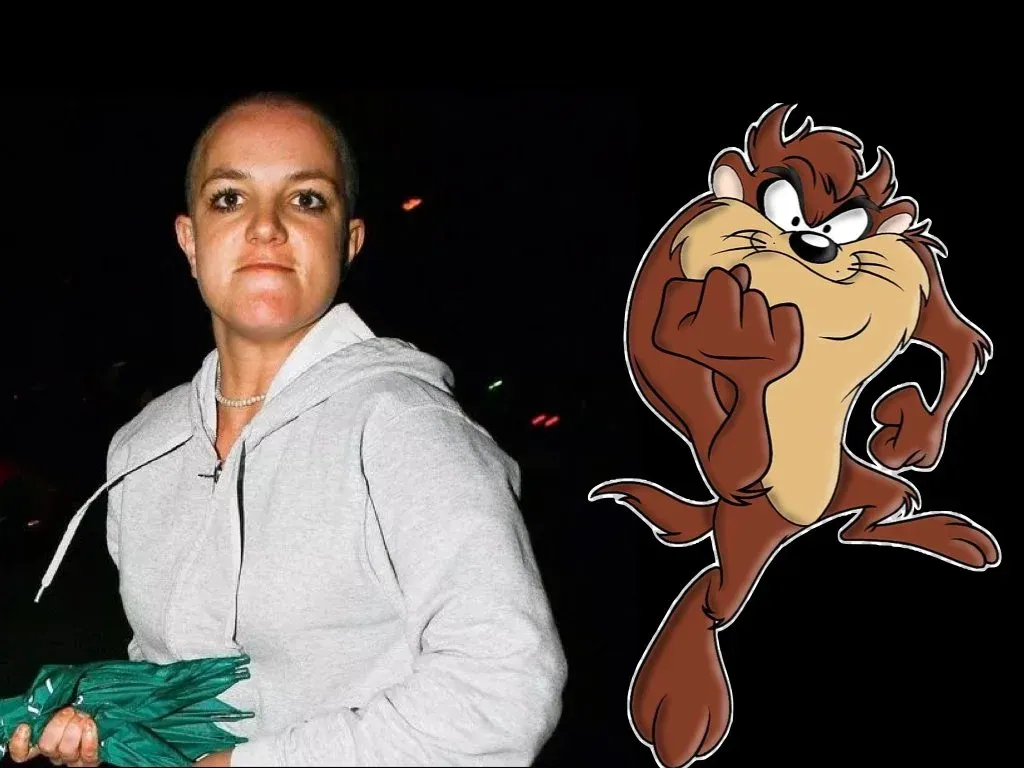
In this frame, Britneys exaggerated grimace slips into cartoon territory — her rage caught in a still that could be mistaken for Looney Tunes. The paparazzi lens doesn’t just document; it caricatures, reducing a human breakdown into animated spectacle. (Image: Backgrid/X17Online)
That’s why I think the moment belongs closer to performance art than tabloid trash. Marina Abramović sat silently in a museum. Chris Burden got shot as a statement. Banksy shredded a painting at auction. Britney shaved her head and swung an umbrella in a parking lot. Whether intentional or not, the effect was the same: a ritual exposing the cracks in the spectacle. And memes sealed the deal. “2007 Britney” now lives on as a shorthand for burnout, a modern myth retold in tote bags and TikToks.
So what’s the moral? Maybe that humans aren’t built to play gods. When we try, it almost always curdles into parody. Britney didn’t just reveal the archetype of the pharaoh; she revealed its limits. Divinity filtered through modernity looks absurd, ironic and self-destructive. A god revealed — but revealed as comedy. And that’s why the image won’t die. Britney 2007 is tragic, punk, divine, and absurd all at once. A meme that functions like myth. Nietzsche’s prophecy fulfilled, but in Walmart lighting: the gods return, only now they wear gym shorts and wield green umbrellas.